
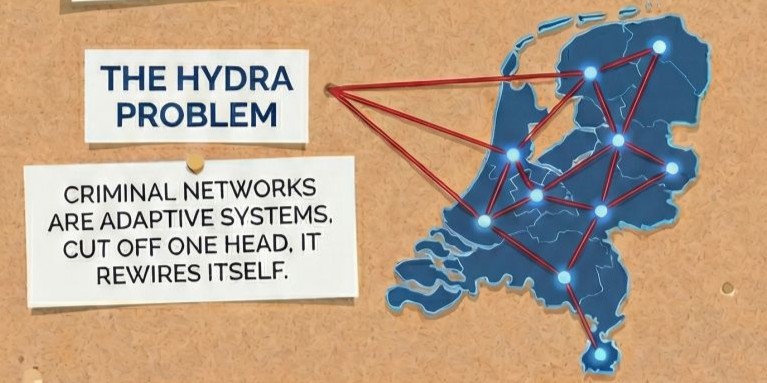

Casper van Elteren, Vítor V. Vasconcelos and Mike Lees published an article in PNAS that has already attracted considerable attention for its counterintuitive findings on police interventions and criminal networks.
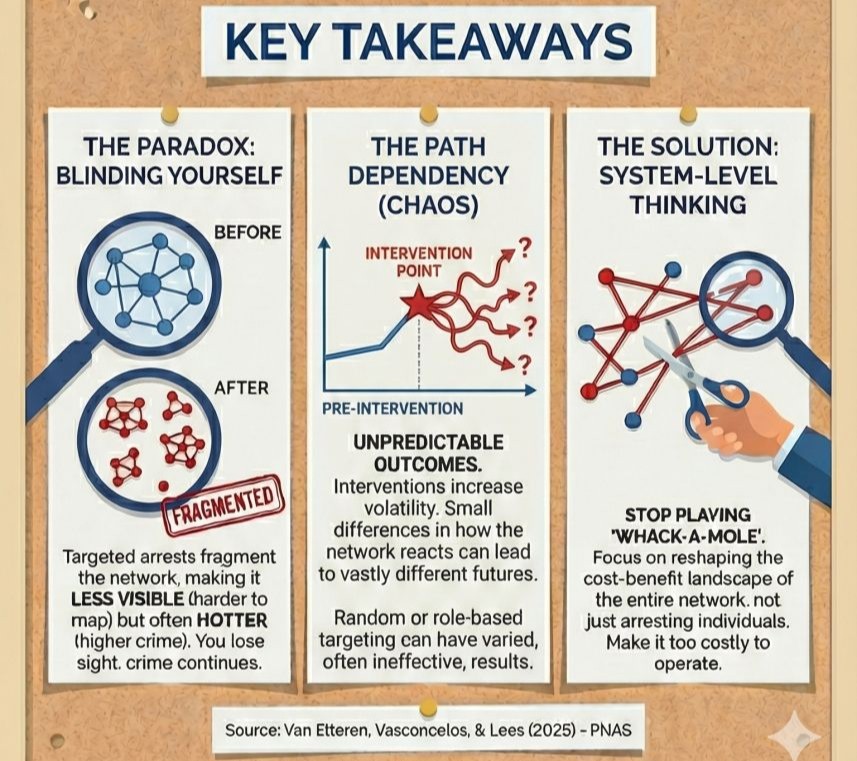
In collaboration with the Dutch police, the researchers combined unique intelligence data from Dutch criminal organisations with computational network modelling. The study examines how these networks respond to targeted actions such as arresting key individuals or encouraging them to stop their criminal activity.
The results reveal a “paradox of intervention”. While aforementioned actions can fragment criminal networks, they often do not eliminate them. Instead, networks tend to reorganise into smaller, more decentralised, and sometimes more active structures, making them harder to detect and disrupt in the long run. The findings highlight criminal networks as highly adaptive systems and suggest that effective policy should move beyond individual arrests to consider how interventions reshape the broader strategic and economic environment.
Links and media coverage:
– Article
– University of Amsterdam press release (EN)
– Dutch media article + interview recording (BNR) – hear Casper van Elteren discuss the study for a broader audience (NL)
– Belgian media article (NL)